King vs Queen Mattress: Size, Room Fit and Which to Choose

Grecian Finds is reader-supported. When you buy through links on our site, we may earn an affiliate commission — it never costs you extra.
King vs queen mattress — the short answer: a King is 16 inches wider than a Queen (76 x 80 inches vs 60 x 80 inches) with the same length. Pick a King if two people share the bed and the room is at least 12 x 12 feet. Pick a Queen if the room allows it (at least about 120 sq ft) and you want the most popular, easiest-to-furnish size. And if you are one sleeper in a small room under 120 sq ft, the mattress size chooser recommends a Twin XL instead — a Queen squeezed into a 10 x 10 room leaves almost no space to walk around the bed.
The two sizes look similar in a showroom, but they feel very different at 3 a.m. Sixteen extra inches is the difference between elbows in your ribs and a full night’s sleep. This guide compares them on the numbers that matter — dimensions, space per person, room fit, bedding cost and moving day — so you can choose once and sleep on it for years.
What are the dimensions of a king vs queen mattress?
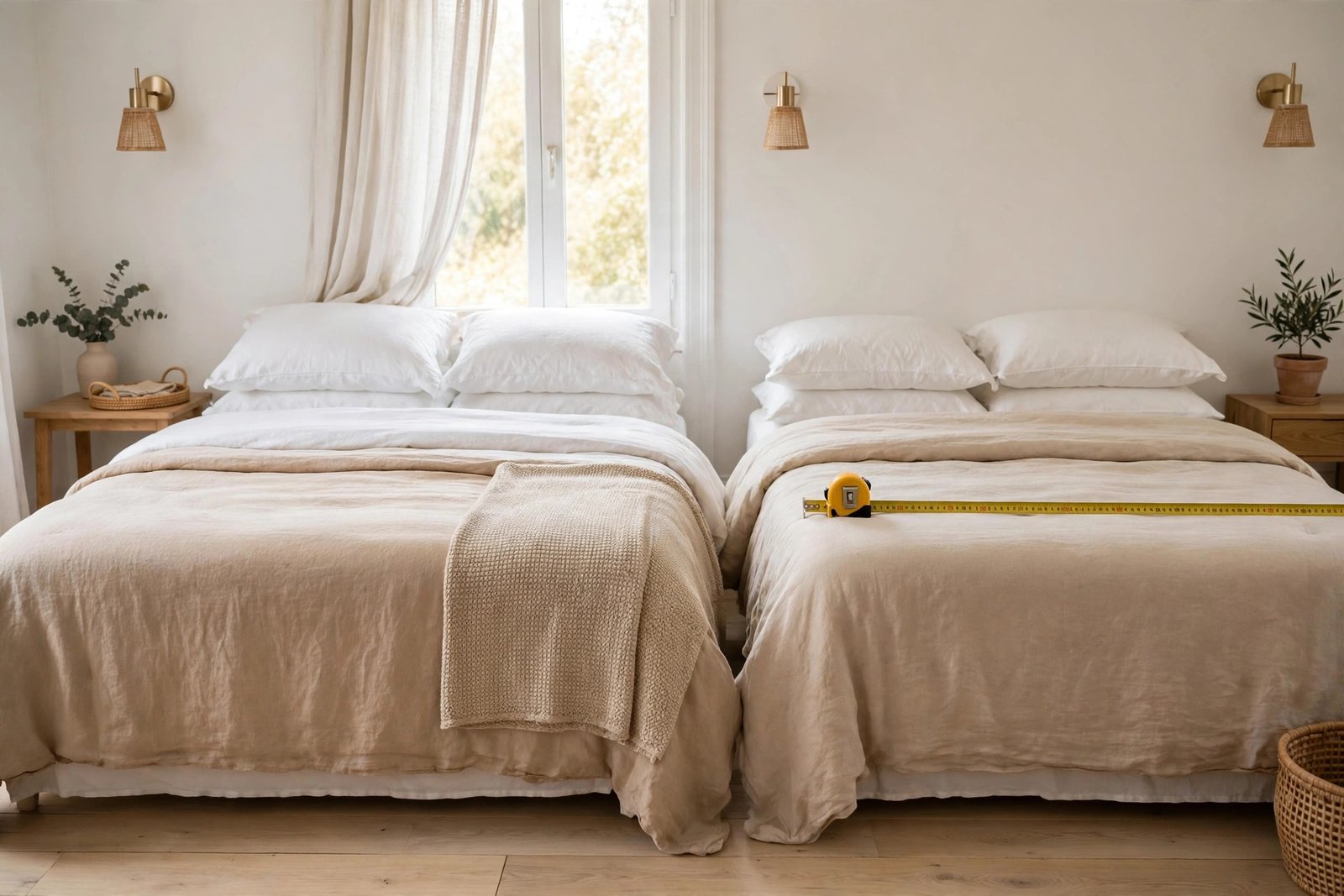
A Queen measures 60 inches wide by 80 inches long (152 x 203 cm). A King measures 76 inches wide by 80 inches long (193 x 203 cm). Same length, 16 inches more width. That extra width is the whole point of a King: it is essentially two Twin XL mattresses side by side, so each sleeper gets a full Twin XL of personal space.
Here is the full mattress size chart for context, in inches and centimetres:
| Size | Inches (W x L) | Centimetres | Best for |
|---|---|---|---|
| Twin | 38 x 75 | 97 x 191 | One child or a small guest room |
| Twin XL | 38 x 80 | 97 x 203 | One adult, especially in a small room |
| Full / Double | 54 x 75 | 137 x 191 | One adult on a budget |
| Queen | 60 x 80 | 152 x 203 | One sleeper with room to spare, or two close sleepers |
| King | 76 x 80 | 193 x 203 | Two sleepers who want real elbow room |
| California King | 72 x 84 | 183 x 213 | Tall sleepers who need extra length |
If you are still torn between the two, the quickest way to settle it is to answer three questions — sleepers, room size and sprawl — in our king vs queen mattress chooser. It gives you a recommendation with room-fit notes, rather than a generic size chart.
How much space does each person actually get?
This is where the King earns its price. On a Queen, two people each get 30 inches of width — about the width of a baby’s cot, and less than a Twin mattress each. On a King, each person gets 38 inches, exactly a Twin XL each. That 8 inches per person is the difference between sleeping and merely sharing a bed.
Think about how you actually sleep. If you and your partner both sleep still, on your sides, and rarely roll over, a Queen can work. If either of you sprawls, tosses and turns, runs hot and needs space from a warm body, or you share the bed with a child or a dog, a Queen starts to feel small fast. A King is not a luxury in that case — it is the size that lets both people sleep through the night.
For one sleeper, a Queen is generous: 60 inches all to yourself, room to starfish, and space for a pet at the foot of the bed. But that only holds when the room allows it. One sleeper in a small bedroom under 120 sq ft is better served by a Twin XL — the chooser’s recommendation for that exact situation — because the bed should not eat the whole room.
What size room do you need for a king bed?
A King needs a bedroom of at least 12 x 12 feet (144 sq ft), and ideally more. You need 24 to 30 inches of clear space on each side of the bed and at the foot, so you can walk around it, open drawers and make the bed without climbing over it. In a 12 x 12 room, a King plus two bedside tables fills the wall and leaves just enough walking room — it works, but there is little space left for a dresser or a chair.
A Queen needs less, but not as little as people assume. A Queen fits comfortably from about 10 x 12 feet (120 sq ft) upwards, with the same 24 to 30 inches of clearance. A 10 x 10 foot room is 100 sq ft — below the 120 sq ft line — and a Queen in there leaves only a narrow path around the bed and no room for bedside tables. That is why the chooser recommends a Twin XL for a single sleeper in a room that small, and a Queen only when the room allows it.
| Bed size | Minimum room | Comfortable room | Clearance to leave |
|---|---|---|---|
| Queen (60 x 80 in) | About 10 x 12 ft (120 sq ft) | 11 x 13 ft or larger | 24–30 in on each side |
| King (76 x 80 in) | 12 x 12 ft (144 sq ft) | 12 x 14 ft or larger | 24–30 in on each side |
| California King (72 x 84 in) | 12 x 12 ft (144 sq ft) | 12 x 14 ft or larger | 24–30 in on each side |
Measure before you order, not after delivery. Tape the outline of the mattress on the floor with painter’s tape, put your bedside tables in place, and walk the route you would take at night. If you have to sidestep to get past the bed, the size is too big for the room.
What is the difference between a King and a California King?
A standard King is 76 by 80 inches. A California King is 72 by 84 inches — 4 inches narrower, but 4 inches longer. Choose a California King if either sleeper is tall (over about 6 ft 2 in) and regularly finds their feet hanging off the end of an 80-inch bed. Choose a standard King if you want the maximum width, which is what most couples actually need.
The catch with a California King is everything around it: sheets, mattress protectors and bed frames are all harder to find and usually cost more than standard King versions, and not every mattress brand makes one. Unless height is the problem, the standard King is the safer, cheaper-to-furnish choice.
Who should pick a Queen, and who should pick a King?
Pick a Queen if: you sleep alone and your room is at least about 120 sq ft; you share with a partner who sleeps still and you are both comfortable close together; you want the widest choice of mattresses, sheets and bed frames at the lowest prices; or your room, doorways or stairs cannot take a King. Queen is the most popular mattress size for a reason — it is the sweet spot of comfort, price and availability.
Pick a King if: two people share the bed and either of you is a restless or sprawling sleeper; you co-sleep with a small child or a dog; one of you works different hours and needs to get in and out without waking the other; or you simply want a Twin XL each. If the room is at least 12 x 12 feet, the King is the better sleep, night after night.
Pick a Twin XL instead if: you sleep alone in a small room under 120 sq ft. It is the same 80-inch length as a Queen or King, so tall sleepers fit fine, but at 38 inches wide it leaves room for a desk, a dresser and a clear path to the door. Two Twin XLs pushed together also make a split King later — a useful upgrade path if you move to a bigger room.
Price-wise, expect a King mattress, frame and bedding to cost noticeably more than the Queen equivalents — often a few hundred dollars more across the full set, depending on brand. Queen bedding is the easiest to find and the cheapest of the two, and almost every mattress is made in Queen. If budget is tight and the room is borderline, a Queen is the sensible compromise; if sleep quality is the priority and the room fits a King, the extra cost pays for itself in better nights.
Shopping for either size? You can browse queen mattresses on Amazon or browse king mattresses on Amazon — check the listed dimensions against your room measurements before you buy, and confirm the delivery and returns terms, as King mattresses are heavy and awkward to return.
Will a King mattress fit through your door?
Measure this before delivery day. A King mattress is 76 inches wide and does not bend — unlike a mattress-in-a-box, a traditional King will not fold around a tight stairwell. Measure your front door, hallway turns, stairwell width and ceiling height, and the bedroom door itself. Standard interior doors are 30 to 32 inches wide; a King needs to be carried in on its side and turned, which needs a clear run of at least 80 inches in the hallway or landing.
If the route is tight, a mattress-in-a-box (compressed and rolled) or a split King — two Twin XLs — solves the problem, since each half is only 38 inches wide. Apartments, older houses with narrow stairs, and top-floor bedrooms are the classic King-delivery traps. A Queen, at 60 inches wide, is easier to manoeuvre but still worth measuring for.
Once the bed is in, think about the rest of the room. A King bed in a cold bedroom is a lot of surface to keep warm — our guide to a heated king blanket for cold bedrooms covers how to pick one by even heat and auto shut-off, which matters more on a King than on any smaller bed.
Still unsure? Let the chooser decide
If you have read this far and still cannot decide, that is exactly what the tool is for. Answer three questions — how many sleepers, how big the room is, and how much you sprawl — and the king vs queen mattress chooser will recommend a size with room-fit notes. It agrees with everything above: Twin XL for one sleeper in a small room under 120 sq ft, Queen when the room allows, King for two sleepers with the space for it.
Frequently asked questions
What is the difference between a King and a California King?
A standard King is 76 by 80 inches and a California King is 72 by 84 inches — the California King is 4 inches narrower but 4 inches longer. Choose a California King if either sleeper is tall; choose a standard King if you want the maximum width.
What size room do you need for a king bed?
At least 12 by 12 feet (144 sq ft), with 24 to 30 inches of clearance on each side and at the foot of the bed. A 12 by 14 foot room or larger is more comfortable, especially with bedside tables and a dresser.
Can a Queen mattress fit in a 10 x 10 room?
It will physically fit, but it is too tight to live with — a 10 by 10 room is 100 sq ft, and a Queen leaves only a narrow path around the bed and no room for bedside tables. For a single sleeper in a room that small, the chooser recommends a Twin XL; choose a Queen only when the room is at least about 120 sq ft.
What is the best mattress size for a single sleeper?
A Queen, when the room allows it — at 60 by 80 inches it is roomy for one sleeper and bedding is easiest to find and cheapest in Queen. But in a small bedroom under 120 sq ft, a Twin XL is the better pick: same 80-inch length, far more floor space left over. A King is more bed than one sleeper needs.
What is the most popular mattress size?
Queen. It is the best-selling size because it suits one sleeper generously and two sleepers adequately, fits most bedrooms from about 120 sq ft, and has the widest choice of mattresses, frames and bedding at the lowest prices.
What size mattress do I need for two people?
A King if the room is at least 12 by 12 feet — each person gets 38 inches, a Twin XL each. A Queen works for two people who sleep still and close together, giving each person 30 inches, but restless sleepers, co-sleeping families and anyone who sprawls will sleep better on a King.