How to Measure Yourself for Jeans That Actually Fit (Waist, Inseam & Vanity Sizing)

Grecian Finds is reader-supported. When you buy through links on our site, we may earn an affiliate commission — it never costs you extra.
Measure your natural waist with a soft tape, level and snug, after a normal breath out. Measure your inseam down the inside of your leg, from the crotch to the ankle bone. Then run those two numbers through a jeans size converter to get your size in US, UK, EU and Japanese sizing — and never trust the number on the tag alone. That is the whole method, and it takes about two minutes. The rest of this post shows you exactly where to put the tape, why the tag lies, and what to do when two brands disagree about your size.
If you already know your measurements and just want to shop, our companion guide How to Buy Jeans Online Without Guessing Your Size covers the ordering checklist — brand charts, returns, and what to check before you pay. This post is the measuring companion to it: get the numbers right here first.
How do I measure my waist for jeans?
Your jeans waist is not your trouser waist, and it is not where your belt sits. It is your natural waistline — the narrowest point of your torso, usually just above your belly button. Find it by tipping side to side: the crease that forms is your natural waist.
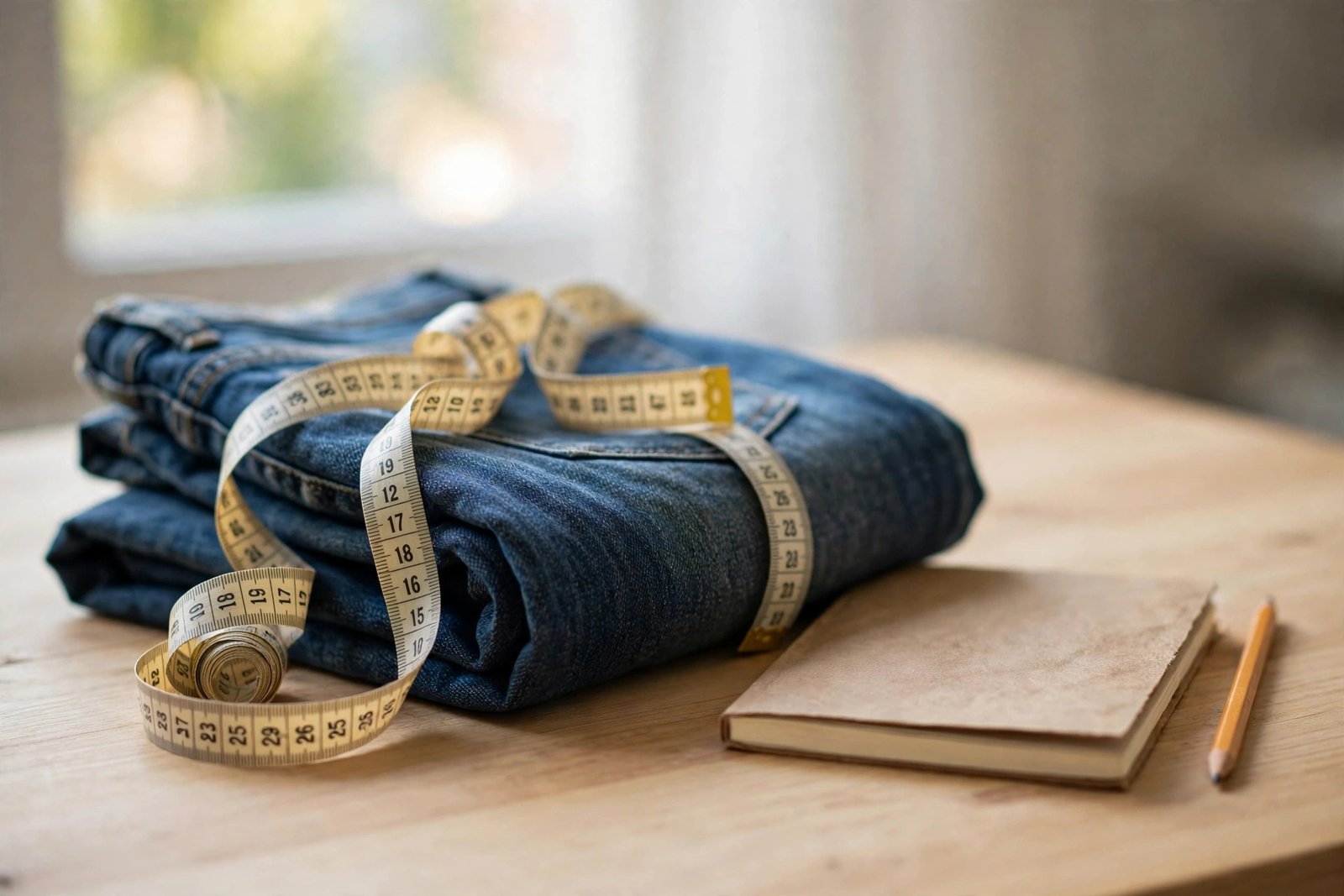
Stand straight and relaxed, feet shoulder-width apart. Wrap a soft tailor’s tape around your natural waistline, keeping it level all the way round — check in a mirror, because a tape that dips at the back reads an inch too big. Let it sit snug against your skin without pressing in. Breathe out normally, then read the number. Do not suck in, and do not pull the tape tight: jeans are worn for hours, not for a photo.
Take the measurement three times and use the middle number. If the three readings differ by more than half an inch, you are probably moving the tape between readings — keep your posture the same each time.
Three mistakes ruin this measurement more than any others:
- Measuring over thick clothes. A hoodie or a thick jumper adds an inch or more. Measure over a thin top or directly on skin.
- Pulling the tape tight. A tight tape gives you a smaller number, and then the jeans you order feel a size too small. Snug, not tight.
- Measuring at the hips. Hip measurement is a different number entirely. If you measure where your jeans sit low on your hips, you will order a waist size that gapes at the top.
Write the number down in inches and centimetres. Jeans are sold in inches in the US and UK, but EU and Japanese listings often use centimetres, and converting in your head on a product page is where mistakes happen.
How do I measure my inseam?
The inseam is the length down the inside of your leg, from the crotch to the ankle bone. It decides whether your jeans pool at the shoe, break neatly, or show ankle — and it is the number most people guess at and get wrong.
There are two ways to get it. The standing method: stand straight in bare feet, and have someone else run the tape from the crotch seam down the inside of your leg to the ankle bone. Doing it yourself while standing bends you over and shortens the reading, so a second pair of hands is worth it. The easier method, and the more reliable one: take a pair of jeans that already fits you well, lay them flat on a table, and measure from the crotch seam straight down the inside leg to the hem. That number is your inseam, and it already accounts for how you like your jeans to sit.
For men, the inseam is the second number in the familiar waist × inseam format — a 34×32 is a 34-inch waist with a 32-inch inseam. Common inseams are 30 for shorter legs, 32 for regular, and 34 for long. For women, brands usually translate the same length into short, regular and long: roughly, short suits an inseam under 30 inches, regular covers 30 to 32, and long starts around 33 — but the exact cut-offs vary by brand, so check the brand’s own chart rather than guessing from the label.
One warning: never measure your inseam from the outside of your leg, hip to ankle. That is your outseam, and it is several inches longer. Ordering by the outseam is how jeans arrive looking like stilts.
Why do my size-32 jeans not measure 32 inches?
Because the tag is not a measurement — it is a label, and labels lie. This is vanity sizing. Most brands cut their jeans one to two inches larger than the number on the tag, and then add another inch or so of ease, the extra room built in so the jeans are comfortable to sit in. A pair labelled 32 can easily measure 33 to 35 inches around the waistband when you lay it flat and measure it.
It gets worse: brands do not share a fit model. Each brand grades its sizes from its own fit model’s body, so a 32 in one brand can be a 33 or a 34 in another, even in the same cut. A slim fit and a relaxed fit from the same brand are not the same garment either — the same waist number sits differently because the rise and the thigh are cut differently.
None of this means your tape is wrong. It means the tag was never meant to be a ruler. Trust your measured waist, and use the tag only as a rough starting point for which size to try first.
What do I do when the same size fits differently in two brands?
Trust the tape, not the tag. Your waist and inseam numbers do not change between brands — only the labels do. Here is how to handle the disagreement:
- Check the brand’s own size chart first. Match your measured waist to the brand’s waist column, not to the size you wore last time. The marketplace chart is generic; the brand chart is the one the jeans were actually cut from.
- Read the fit note. When a listing says a cut runs small, or that a model is wearing a size down, believe it over the number.
- Rigid denim: size up. Rigid, non-stretch denim has no give. If you are between sizes, take the larger one — it will not stretch to meet you.
- Stretch denim: buy snug. Denim with 1–3% elastane relaxes by roughly an inch with wear. If you are between sizes, take the smaller one; it will give.
- Order two sizes when returns are free. If a new brand offers free returns, order your measured size and one up, keep the one that fits, and send the other back. One return costs less than a pair of jeans that lives in a drawer.
How do I turn my measurements into a size?
Take your two numbers and convert them. A worked example: a man with a 34-inch waist and a 32-inch inseam orders a 34×32 in US sizing. That same waist is a UK 34, an EU 50 and a JP 84 — men’s US and UK jeans sizes use the same inch number, EU adds 16, and Japanese sizes follow the chart on the converter page. A woman with a US size 8 is a UK 12, an EU 38 and a JP 11 — women’s UK sizes run 4 higher than US.
Then run it through our jeans size converter to get your size in US, UK, EU and Japanese sizing. The full jean size conversion chart is on the converter page, or read it off the jeans size conversion chart on the same page.
| Men’s waist (inches) | US / UK | EU | JP |
|---|---|---|---|
| 30 | 30 | 46 | 76 |
| 32 | 32 | 48 | 81 |
| 34 | 34 | 50 | 84 |
| 36 | 36 | 52 | 89 |
| Women’s US size | UK | EU | JP |
|---|---|---|---|
| 8 | 12 | 38 | 11 |
| 10 | 14 | 40 | 13 |
| 18 | 22 | 48 | 21 |
Women’s EU sizing is less tidy than men’s: an EU 38 covers roughly a US 6 to 8, so check your exact size on the chart rather than guessing from one rule. The numbers above come from the converter page’s own charts — use the converter itself for any size not listed here.
What should I buy once I know my size?
Once your numbers are written down, the jeans themselves are the easy part. Two reliable starting points, both widely stocked on Amazon in a full run of waist and inseam sizes:
- Levi’s Men’s 511 Slim Fit Jeans — the classic slim fit, available in waist × inseam sizing so you can order your exact measurements. List price $69.50, often discounted to around $30–$50 depending on size and colour. Check the price on Amazon
- Levi’s Women’s 711 Skinny Jeans — a mid-rise skinny fit sold by US size with short, regular and long lengths. List price $69.50, with most sizes discounted. Check the price on Amazon
And if you do not own one yet, get a soft tailor’s tape before you order anything — a steel tape will not wrap round a waist properly, and a phone app is not a substitute. Soft measuring tape on Amazon
Prices checked 9 November 2026. Jeans prices vary by size and colour, so check the live price on the listing before ordering.
Frequently asked questions
How often should I re-measure for jeans?
Re-measure whenever your weight has changed by more than a few pounds, and at least once a year even if it has not — bodies shift gradually, and jeans sizes creep with them. Always re-measure before ordering from a brand you have never tried, even if you bought jeans last month.
Do I measure over or under clothes?
Under. Measure over a thin top or directly on skin. Measuring over a hoodie, a thick jumper or another pair of jeans adds an inch or more and pushes you a size up for no reason.
Why does the same size fit differently in two brands?
Because each brand grades from its own fit model and adds its own amount of ease and vanity sizing. A 32 in one brand can measure 33 inches at the waistband and 35 in another. Your tape measurement is the constant — the brand’s chart is what translates it.
Should I measure standing up or lying down?
Standing up, relaxed, for your body measurements — that is how jeans are worn. The lying-down method is for measuring a pair of jeans that already fits: lay them flat, measure the waistband across and double it, and measure the inseam from the crotch seam to the hem. Both methods work; do not mix them up.
Converting shoe sizes too? Our shoe size converter does the same job for footwear — measure your foot, then convert. And if you want the full ordering checklist, start with how to buy jeans online without guessing your size.