How to Measure Your Bra Size at Home (With or Without a Tape)

Grecian Finds is reader-supported. When you buy through links on our site, we may earn an affiliate commission — it never costs you extra.
Yes, you can measure your bra size at home in about five minutes, with or without a tape measure. Take three underbust readings (loose, snug and tight) and three bust readings (standing, leaning and lying), write them down, and enter them in a bra size calculator to get your US, UK and EU size. No tape? A piece of non-stretch string and a ruler works just as well — this guide shows you exactly how.
Most people wear the wrong size, usually a band that is too loose and a cup that is too small. That is not a body problem. It is a measuring problem — and it is fixable in one quiet afternoon, in your own bedroom, with no fitting room and no awkwardness.
What do you need to measure your bra size at home?
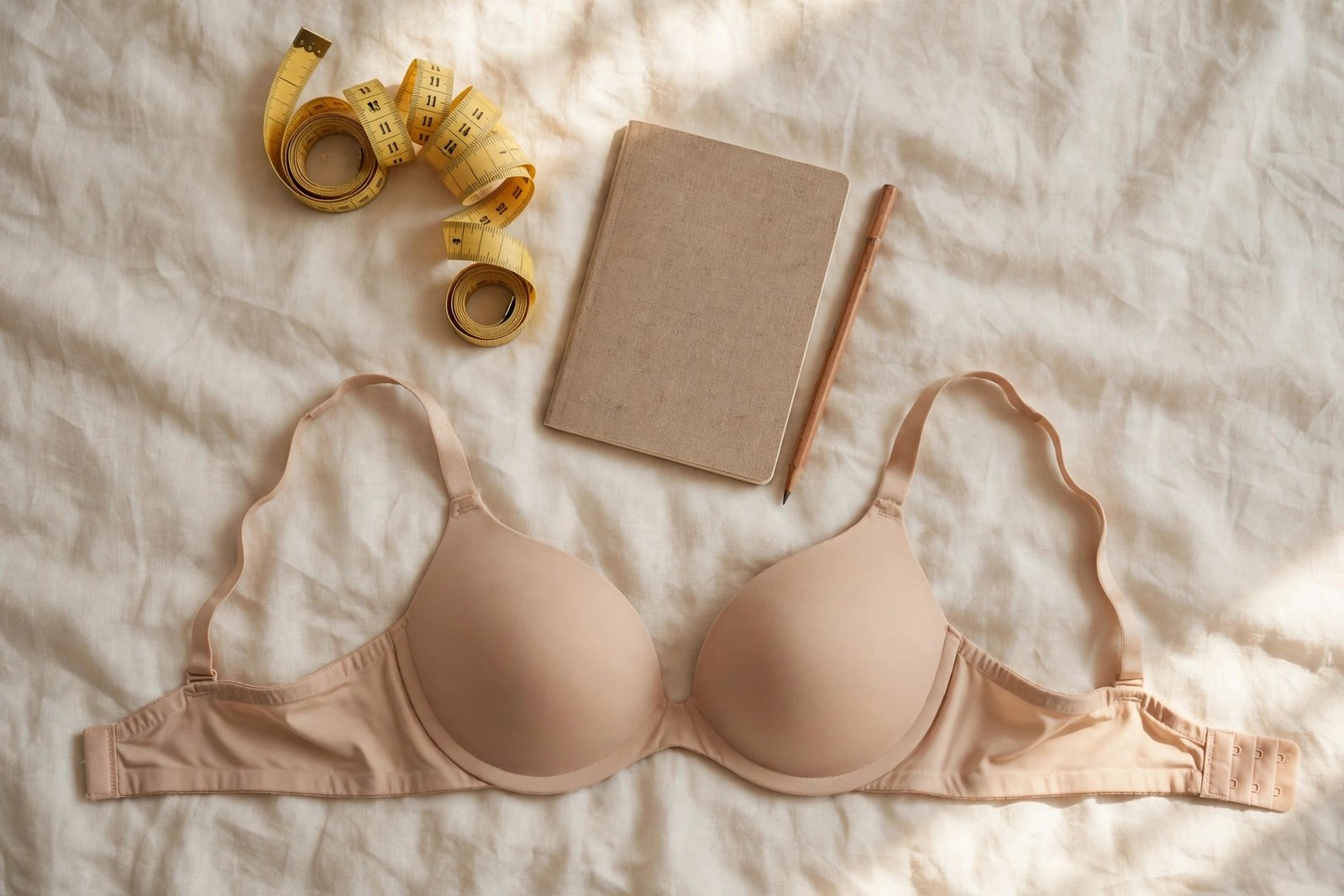
Keep it simple. You need a soft fabric measuring tape, a mirror, a pen and paper, and about five minutes. Wear an unpadded, non-push-up bra, or measure without a bra if you are comfortable doing so — a padded bra adds volume that is not yours and throws the bust reading off.
If you do not own a soft tape, any flexible 60-inch / 150 cm tape will do. A soft measuring tape for body measurements on Amazon costs very little and is useful for jeans, dresses and waist measurements too. No tape at all? Skip ahead to the string-and-ruler method below — you can still get accurate numbers today.
Stand in front of a mirror so you can see whether the tape is level all the way around. Breathe out naturally before each reading, and do not pull the tape so tight it digs in — except where a reading specifically asks for a tight measurement.
What is the 2-number shortcut vs the 6-measurement method?
The classic method uses two numbers: one underbust measurement for the band, and one bust measurement for the cup. It works, roughly, for many people. But it misses a lot — breast shape, tissue softness and how much your bust moves between positions all change the result.
The method our bra size calculator uses takes six readings instead: three around the ribcage and three around the bust. Each one catches something the others miss, and together they give a size — plus sister sizes and fit notes — that a single pair of numbers cannot.
| Method | Measurements | Best for | Limitation |
|---|---|---|---|
| 2-number shortcut | 1 underbust, 1 bust | A quick starting size | Misses shape and tissue differences; often lands one band too big |
| 6-measurement method | Loose, snug and tight underbust; standing, leaning and lying bust | The most accurate at-home size | Takes five minutes instead of one |
If you are in a hurry, do the two-number version now and the six-measurement version later. If you want the size you can actually shop with, do all six. The extra four minutes are worth it.
How do you measure your underbust?
Your underbust — the measurement directly under your bust, around your ribcage — sets your band size. It is the most important number of the six, so take your time with it.
1. Loose underbust. Wrap the tape around your ribcage directly under your bust, level all the way around, and let it sit comfortably without pressing in. Breathe out and read the number.
2. Snug underbust. Repeat the same measurement, this time pulling the tape firm against your skin — snug, but not tight enough to indent. This is the reading that sets your band size in the calculator, so be honest with it: a band that feels fine loose in the shop will ride up within an hour.
3. Tight underbust. Pull the tape as tight as you comfortably can, as if the tape were a firm band. This number tells the calculator how much your ribcage compresses, which is how it works out whether to size your band up or down.
Write down all three numbers immediately, in inches or centimetres. Do not round to the nearest whole number if you can avoid it — a half inch matters here. If a reading falls between two marks, note the smaller one for the snug reading and the larger one for the loose reading.
How do you measure your bust?
Your bust measurement sets your cup size. Take it around the fullest part of your bust, keeping the tape level and loose enough that it does not press breast tissue flat.
1. Standing bust. Stand upright, arms relaxed at your sides, tape around the fullest part. Keep it level — check in the mirror that it has not dipped at the back. This is the number most guides stop at. It is only one of three.
2. Leaning bust. Bend forward at the hips until your back is roughly parallel to the floor, and let your bust hang naturally. Measure loosely around the fullest part. This is the most important bust reading for many people, because standing compresses tissue against the chest and hides volume the leaning reading catches. Do not skip it.
3. Lying bust. Lie flat on your back on a bed or the floor and measure around the fullest part. Gravity spreads tissue differently lying down, and this third reading helps the calculator judge shape — whether your tissue is fuller on top, fuller at the bottom, or evenly spread.
Take each bust reading twice if the numbers disagree by more than half an inch. Your body is not a fixed object; a small difference between attempts is normal. Use the second reading if it feels more settled.
How do you measure your bra size without a measuring tape?
No soft tape? You can still measure accurately with a piece of non-stretch string or ribbon and a ruler or a hard tape measure.
Wrap the string around yourself exactly as you would a tape — underbust first, then bust, in the same positions described above. Pinch or mark the string where it meets, then lay it flat against a ruler and read the length. Do this for all six measurements, one at a time, and write each number down before moving on.
Two things make or break the string method. First, the string must not stretch: cotton string, ribbon or a phone-charging cable you can mark will work; elastic, yarn and stretchy cord will not. Second, keep the string level and snug in the same way a tape would be — a slack string adds an inch you do not have, and a pulled-tight string takes one away.
Once you have your six numbers, enter them in the bra size calculator exactly as if you had used a tape. The calculator does not care how you got the numbers, only that they are accurate.
How do you measure your bra size with sagging breasts?
If your breasts sit lower or have softer tissue, the leaning bust measurement matters even more. Standing compresses tissue against the chest wall, so a standing-only measurement can underestimate your cup by one or even two sizes.
Bend forward 90 degrees and measure loosely around the fullest part, letting the tissue hang naturally. That leaning number is the one that catches the volume your standing reading misses. Enter all three bust readings — standing, leaning and lying — and the calculator will flag a projected shape if your leaning reading is much larger than your standing one.
A projected shape changes which styles fit best, not your size. Moulded, smooth cups tend to gap at the top on projected shapes, while seamed, unlined styles follow the shape of the breast and usually fit better. If you keep getting gaping at the top of moulded bras in a size that otherwise fits, shape — not size — is the likely cause.
What are the most common measuring mistakes?
- Tape not level. If the tape dips at the back, the reading is too big. Check in a mirror every time.
- Measuring over a padded bra. Padding adds volume that is not yours. Wear an unpadded bra or no bra.
- Adding 4 inches to the underbust. This old rule is outdated. It gives a band that is too big and a cup that is too small. Use your snug underbust directly — the calculator does the rest.
- Pulling the bust tape tight. The bust tape should sit on the skin, not press tissue flat. If it leaves a mark, it was too tight.
- Rounding up every reading. Rounding the band up and the bust down is how people end up two sizes off. Note halves and quarters.
- Measuring once, on a bad day. Bloating, your cycle and a heavy meal all change the numbers slightly. If a reading looks odd, re-take it tomorrow.
When should you re-measure your bra size?
Re-measure every 6 to 12 months, and any time your body changes: after weight gain or loss of more than a few pounds, after pregnancy or breastfeeding, when you start or change a workout routine that builds chest or back muscle, and after menopause. Bodies change gradually, and a bra that fitted perfectly last year can quietly stop fitting this year.
Also re-measure if your current bras show the classic signs of a wrong size: the band rides up at the back, the straps dig in or keep slipping, the centre gore does not sit flat against your chest, the cups wrinkle or gap, or breast tissue spills over the top or sides. Any one of those is worth five minutes with a tape.
What should you do with your six numbers?
Enter them in our free bra size calculator — it takes inches or centimetres and gives your size in US, UK and EU sizing, plus sister sizes if your usual size is out of stock, and fit notes based on your shape. That is the size to shop with first.
Once you know your bra size, garment sizing is the natural next step — a bra size does not translate directly into a dress or top size. Our Lingerie Size Converter converts your size across systems and garment types, so the number you just worked out keeps working for you beyond bras.
And if you are buying online, order your calculated size and one sister size, try both at home, and keep the one that fits. A five-minute measurement plus a two-size try-on beats a drawer full of almost-right bras every time.
Frequently asked questions
How do I measure my bra size at home?
With a soft measuring tape and a mirror. Take three underbust readings (loose, snug, tight) around your ribcage directly under your bust, and three bust readings (standing, leaning, lying) around the fullest part of your bust. Enter all six in the calculator, in inches or centimetres, and it gives your size in US, UK or EU sizing, plus sister sizes and fit notes.
Can I use the calculator with centimetres instead of inches?
Yes. The calculator takes inches or centimetres, and the sizing-system toggle gives your size in US, UK or EU sizing. EU band sizes are in centimetres (65, 70, 75, 80), while US and UK bands use inches (30, 32, 34).
Do I still add 4 inches to my underbust measurement?
No. The old add-4-inches rule is outdated and usually gives a band that is too big and a cup that is too small. This calculator uses your three underbust readings directly, with the snug underbust setting the band, so do not add anything.
How do I measure my bra size with sagging breasts?
Use the leaning bust measurement. Bend forward 90 degrees and measure loosely around the fullest part of your bust. Standing compresses tissue against the chest, so the leaning reading catches volume the standing reading misses, and the calculator will flag a projected shape — moulded cups tend to gap on projected shapes, while seamed, unlined styles fit better.
How do I measure my bra size without a measuring tape?
Use a piece of non-stretch string or ribbon and a ruler. Wrap the string around yourself in the same positions as a tape — three underbust readings and three bust readings — mark where it meets, then lay it flat against a ruler to read the length. Enter the six numbers in the calculator as normal.