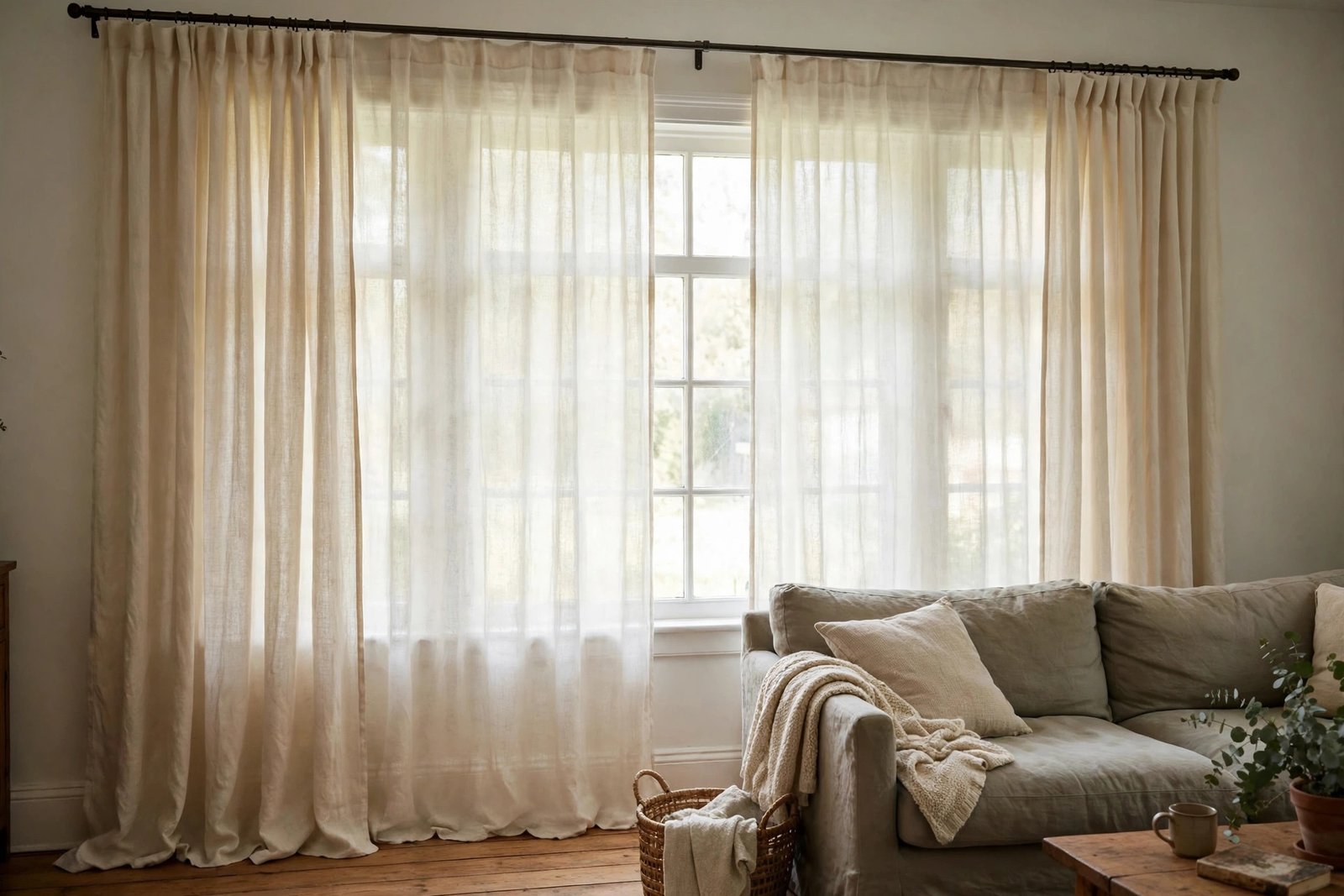
How High to Hang Curtains (and How Wide the Rod Should Be)

Grecian Finds is reader-supported. When you buy through links on our site, we may earn an affiliate commission — it never costs you extra.
Hang the rod 4 to 6 inches above the top of the window frame — or, if you have the wall space, two-thirds of the way up from the frame to the ceiling. That one move makes the window look taller and the room feel bigger, and it costs nothing. The rod should also extend 4 to 6 inches past the frame on each side, so the panels can stack off the glass when they are open. Once the rod position is set, measure from the rod down to the floor: that number, not the window height, is your curtain length.
Most curtains look wrong for exactly two reasons: the rod is too low, and the panels are too short. Both are fixed before you buy anything, with a tape measure and ten minutes. This guide covers how high should i hang a curtain rod, how wide the rod should be, and how to pick the finished length — then you can size your panels with our free curtain size calculator.
How high should I hang a curtain rod?
The standard rule is 4 to 6 inches above the window frame. That gap is enough to clear the trim and let the rod sit visibly above the window, which is what creates the taller-window effect. If your ceiling is high — 9 feet or more — go higher: mount the rod two-thirds of the way from the top of the frame to the ceiling. A rod hung just an inch or two above the frame is the single most common mistake, and it visually shrinks the window.
There are two exceptions. In a room with very low ceilings, 8 feet or under, stick to the 4-to-6-inch rule rather than pushing toward the ceiling, or the rod crowds the cornice and looks cramped. And above a radiator or a piece of furniture that sits under the window, hang the rod at the normal height but choose a shorter finished length — sill length or just below the sill — instead of floor length.
Mark the bracket positions with a pencil before you drill anything. Hold the rod up, step back, and check it from across the room. A rod that looks right from two feet away can look low from the doorway, and moving a pencil mark is free while moving a drilled bracket is not.
How wide should a curtain rod be?
The rod should be 8 to 12 inches wider than the window frame in total — 4 to 6 inches of extra rod on each side. That overhang is not decoration. When the curtains are open, the panels stack on that extra rod instead of covering the glass, so you keep the full window of light and the window looks wider than it is.
For a wide window or a sliding door, scale the overhang up: 6 to 8 inches per side works better than the minimum, because heavier and wider panels need more stacking room. A good test is to hold a panel bunched up at the side of the window — if it still covers glass, the rod is too short.
| Window width | Rod width to buy | Overhang per side |
|---|---|---|
| Up to 36 inches | 44–48 inches | 4–6 inches |
| 36–60 inches | 48–72 inches | 6 inches |
| 60–84 inches | 72–96 inches | 6–8 inches |
| Over 84 inches / sliding doors | 96–144 inches | 6–8 inches |
Adjustable rods make this easy: buy the size range that covers your window width plus the overhang, not the size that just matches the window. A rod extended to its absolute maximum sags in the middle under heavy panels, so pick a range where your width sits in the middle, and add a centre support bracket for any rod over 72 inches. If you still need a rod, a basic adjustable rod is the cheapest part of the whole job — see adjustable curtain rods on Amazon and pick the length range that fits your window plus the overhang.
How do I measure curtain length once the rod is up?
Measure from the top of the rod — or from the bottom of the curtain rings, if you are using rings — straight down to the floor. Do not measure from the window frame. The rod sits 4 to 6 inches above the frame, so a measurement taken from the frame comes up short by exactly that amount, and short curtains are the giveaway that a room was guessed at rather than measured.
Measure in three places: the left end, the middle, and the right end of the rod. Floors are rarely perfectly level, and older houses can vary by an inch or more across a wide window. Use the longest of the three measurements for floor-length panels, so no panel ends up floating.
Then match that number to the nearest ready-made length. Common ready-made lengths are 63, 84, 95 and 108 inches. If your rod-to-floor measurement is 86 inches, 84-inch panels will hang two inches short — go to 95 inches and hem them, or choose a puddle length and let the extra fabric pool. The calculator does this maths for you: enter your rod height and it tells you which standard size to buy.
What are the three finished curtain lengths?
Floor-length curtains come in three finished looks, and the difference is only an inch or two — but it changes the whole feel of the room.
| Finish | How it sits | Best for |
|---|---|---|
| Float | Hem about half an inch above the floor | High-traffic rooms, kids’ rooms, homes with pets — nothing drags or gets stepped on |
| Kiss | Hem just grazes the floor | Living rooms and bedrooms — the most popular designer look, tailored and clean |
| Puddle | 2 to 4 extra inches pooling on the floor | Formal dining rooms and bedrooms with light, flowing fabrics — romantic, but it collects dust |
Kiss is the safe default for most rooms: it looks intentional, it does not trip anyone, and it hides slightly uneven floors better than a float. Puddle only works with soft fabrics such as linen or sheer voile — stiff blackout fabric pooled on the floor looks like a mistake rather than a style choice.
What mistakes make curtains look wrong?
Five mistakes cover almost every bad-looking curtain job, and all five are decided before the panels arrive:
- Rod too low. Mounted on the frame or an inch above it, the window looks short and squat. Fix it with the 4-to-6-inch rule.
- Panels too short. Curtains that stop inches above the floor look like they shrank in the wash. Measure rod-to-floor, not frame-to-floor.
- Panels too narrow. One flat panel across a window looks skimpy. Total panel width should be at least 1.5 times the rod width — 2 times for a full, gathered look.
- Rod too short. Panels bunched over the glass block light and make the window look smaller. Add 4 to 6 inches of overhang per side.
- Wrong finish for the room. Puddled curtains in a hallway get stepped on; floating curtains in a formal dining room look unfinished. Match the finish to how the room is used.
The width mistake is the one people notice least while shopping and most once the curtains are up. A 60-inch rod needs at least 90 inches of panel width in total — two 45-inch panels, for example. Check the panel width on the listing before you buy, not after it arrives.
How do I put it all together?
Work in this order and you only measure once: hang the rod 4 to 6 inches above the frame, with 4 to 6 inches of overhang on each side. Measure rod-to-floor in three places and take the longest. Pick your finish — kiss for most rooms — and match the number to the nearest ready-made length. Then check the total panel width is at least 1.5 times the rod width.
Once the rod position is set, sizing the panels takes a minute: use our free curtain size calculator — enter your window width and rod height and it gives you the panel width and length to buy. And if you are sizing the rest of the room too, our rug size calculator for the living room works the same way, so the rug and the curtains stop fighting each other for attention.
Frequently asked questions
How high should I hang a curtain rod?
Hang the rod 4 to 6 inches above the top of the window frame. If you have high ceilings, mount it two-thirds of the way from the frame to the ceiling instead — the higher rod makes the window and the room look taller.
How wide should a curtain rod be?
The rod should be 8 to 12 inches wider than the window frame in total, which is 4 to 6 inches of overhang on each side. The extra rod lets the panels stack off the glass when open, so you keep the full window of light.
How long should curtains be — kiss, float or puddle?
Floor-length panels should just kiss the floor — that is the most popular designer look. Float means the hem sits about half an inch above the floor, which suits high-traffic rooms. Puddle means 2 to 4 extra inches pooling on the floor, for formal rooms with soft fabrics.
Which standard curtain length should I buy for my window?
Common ready-made lengths are 63, 84, 95 and 108 inches. Measure from your rod position to the floor and pick the length closest to that measurement — floor-length panels should just kiss the floor, so go up a size and hem if you fall between lengths.
Can I measure for curtains in metres or centimetres?
The calculator takes inches. Measure in inches, or measure in centimetres and divide by 2.54 to get inches before you enter the numbers. Standard ready-made lengths are sold in inches (63, 84, 95, 108), so converting first keeps the recommended size matched to what shops sell.