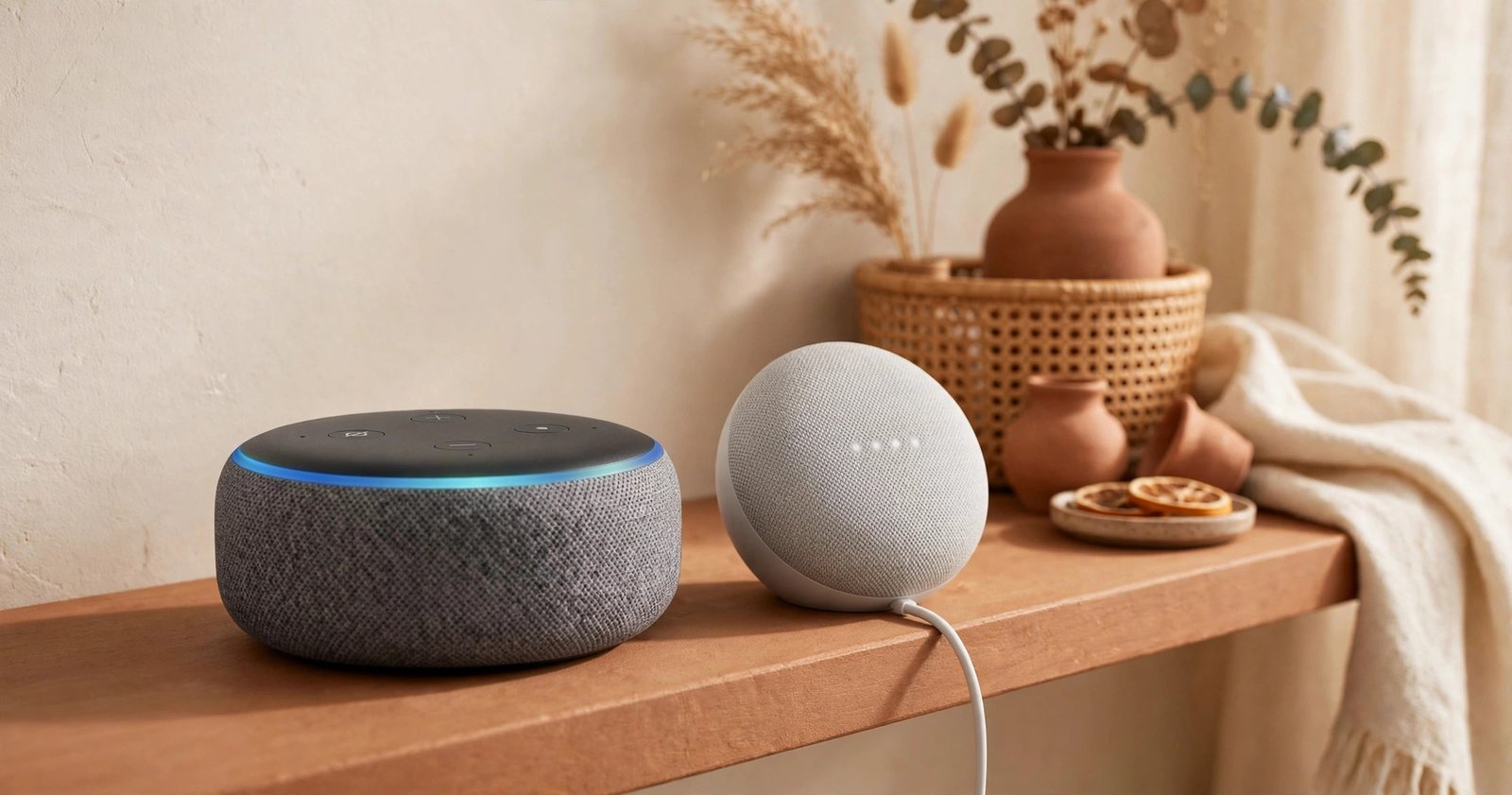
Echo Dot vs Google Nest Mini: Best Budget Smart Speaker (2026)

The short answer: the Amazon Echo Dot (5th gen) is the better budget smart speaker for most people in 2026. It matches the Nest Mini’s price (~$50), packs a temperature sensor, motion detection, and a built-in eero Wi-Fi extender the Nest Mini doesn’t have, and Alexa works with more smart-home devices. The Nest Mini still wins for Google households and wall mounting, and the Apple HomePod mini sounds noticeably better than both — if you’ll pay double.
Grecian Finds is reader-supported. When you buy through links on our site, we may earn an affiliate commission — it never costs you extra.
Quick comparison: Echo Dot vs Nest Mini vs HomePod mini
| Speaker | Assistant | Speaker | Smart home | Best for | Price range* |
|---|---|---|---|---|---|
| Amazon Echo Dot (5th gen) | Alexa | 1.73″ front-firing, mono | Alexa, Matter, temperature + motion sensors, eero extender | Best overall on a budget | ~$35–50 |
| Google Nest Mini (2nd gen) | Google Assistant | 40mm driver | Google Home, Matter, Thread, Chromecast built-in | Google households, wall mounting | ~$30–50 |
| Apple HomePod mini | Siri | Full-range + dual passive radiators, 360° | HomeKit, Matter, Thread border router, AirPlay 2 | Best sound, Apple homes | ~$100–130 |
*Street prices move constantly — confirm the current price before you buy. Check price on Amazon
1. Amazon Echo Dot (5th gen) — best overall budget smart speaker
The 5th-gen Dot is the rare budget gadget that’s still the right buy four years after launch. For ~$50 you get Alexa, a noticeably bigger-sounding 1.73-inch front-firing speaker, and two things neither rival offers at any price: built-in temperature sensing and ultrasound motion detection.
Those sensors are the real story. They turn the Dot into an automation trigger, not just a voice remote — “when motion is detected in the hallway after 10pm, dim the lights,” or “when the bedroom warms up, nudge the fan.” That makes it genuinely useful in a smart home, not just a music box. It also doubles as an eero mesh extender (up to ~1,000 sq ft, speed-capped at 100 Mbps) if you have an eero router.
The honest trade-offs: audio is mono and thin at high volume — pair two Dots for stereo or accept background-listening quality. Amazon Sidewalk ships enabled by default (dig into settings on day one), and Alexa’s answers to open-ended questions still lag behind Google’s. But for smart-home breadth — Alexa supports the widest device ecosystem — nothing at this price comes close.
2. Google Nest Mini (2nd gen) — best for Google households
The Nest Mini is aging hardware — it launched in 2019 and Google has even pulled it from its own store in some regions — but it refuses to die because it’s still excellent at one job: being the cheapest way into a Google-centered home.
Google Assistant remains the smartest conversationalist of the three. It handles follow-up questions, context (“what about tomorrow?”), and general knowledge better than Alexa or Siri. The Mini has a built-in wall-mount slot (the Dot has none), Chromecast built in for audio, and it streams from YouTube Music, Spotify, Apple Music, and Deezer. For a bedroom or kitchen where you mostly ask questions and play background music, it’s all the speaker you need.
The trade-offs: the 40mm driver is the smallest and weakest-sounding of the three — fine for podcasts, thin for music. No temperature or motion sensors, no Wi-Fi extender trick, and Google’s smart-home device support, while solid, trails Alexa’s catalog. And with no refresh since 2019, you’re buying old hardware. Google reportedly replaced it with a Gemini-powered Home Speaker in some markets — check which Google speaker is current in your region before buying.
3. Apple HomePod mini — the wildcard that actually sounds good
Here’s the honest bit: neither the Echo Dot nor the Nest Mini is a good speaker. They’re voice assistants that happen to play music. The HomePod mini flips that — it’s a genuinely good compact speaker that also takes voice commands.
Apple’s full-range driver with dual passive radiators and computational audio produces a wider soundstage and real bass presence that the Dot and Mini can’t touch. It’s also the only pick that works as a HomeKit hub with Thread, supports AirPlay 2 and Apple’s Intercom feature, and hands audio off from your iPhone with a tap. If your household runs on iPhone and Apple Music, this is the obvious choice.
The catch: it costs roughly double (~$99, raised to $129 by Apple in June 2026), Siri is the weakest assistant of the three for general questions, and it essentially requires an Apple device to set up. A refreshed model has been rumored — if you can wait, wait. For non-Apple households, the Dot does more for half the money.
Which budget smart speaker sounds best?
The HomePod mini, and it isn’t close. Its dual passive radiators deliver bass and fullness the others physically can’t match at this size. The Echo Dot comes second — its front-firing 1.73-inch driver is bigger and clearer than before, decent for a small room. The Nest Mini finishes last for music: fine for podcasts and background listening, thin and compressed when you turn it up. If music is the priority and you’re not in Apple’s world, buy two Echo Dots and stereo-pair them.
Alexa vs Google Assistant vs Siri — which assistant is smartest?
Google Assistant wins on brains: best at natural follow-up questions, context, and general knowledge. Alexa wins on utility: widest smart-home device support, best shopping integration, and the most third-party skills. Siri wins on privacy and Apple integration but loses on everything else — it’s still the weakest at open-ended questions and third-party services. Pick the assistant that matches your phone and your patience: Android/Google users, the Nest Mini; everyone else who wants maximum compatibility, the Echo Dot.
Which speaker is best for controlling a smart home?
The Echo Dot, by a clear margin. Alexa supports the broadest range of smart-home devices, and the Dot’s temperature and motion sensors add automation triggers neither rival has. A Dot by the front door can announce visitors and trigger Alexa Routines — handy if you’re pairing it with devices like a video doorbell or a renter-friendly smart lock, since locks, cameras, and lights from almost every brand speak Alexa first. The Nest Mini is fine if your home already runs on Google Home, and the HomePod mini is the pick for HomeKit households — but Siri’s third-party support remains the thinnest of the three.
Which smart speaker is best for privacy?
No smart speaker is a privacy saint, but they differ. The Echo Dot has a physical mic-off button and Alexa lets you review and delete recordings — but Amazon’s ad business and Sidewalk (enabled by default) are the trade-off. Google’s business is also ads, and the Nest Mini has a hardware mute switch, but Google Assistant is deeply tied to your Google data. Apple has the strongest privacy posture of the three — on-device processing where possible, no ad business — which is the HomePod mini’s quiet advantage. If privacy is your top concern and you’re in Apple’s ecosystem, the mini is the answer; otherwise, mute button + deleting recordings regularly is your routine.
For a full rundown of the gear I’d actually put in a starter smart home, see my picks.
Frequently asked questions
Echo Dot vs Nest Mini — which is better?
The Echo Dot (5th gen) is better for most buyers. It matches the Nest Mini’s ~$50 price while adding a temperature sensor, motion detection, a bigger front-firing speaker, and a built-in eero Wi-Fi extender. The Nest Mini is the better pick only if your home already runs on Google Assistant and Google Home devices.
Is the Google Nest Mini still worth buying in 2026?
Only at a discount. The hardware is from 2019 and Google has moved focus to newer Gemini-powered speakers. If you find one under ~$35 and you’re a Google household, it’s still a fine bedside assistant — but don’t pay full price for seven-year-old hardware.
Can the Echo Dot and Nest Mini be used without a subscription?
Yes — both work fully with no subscription. Music streaming uses whatever services you already pay for (or their free tiers), and voice assistant, smart-home control, timers, and routines are all free.
Is the HomePod mini worth it over the Echo Dot?
For sound quality and Apple integration, yes — it’s noticeably better-sounding and doubles as a HomeKit/Thread hub. For everything else (price, assistant smarts, device compatibility), the Echo Dot gives you more for about half the money. Buy the mini if you live in Apple’s world; buy the Dot if you don’t.
The bottom line
Buy the Amazon Echo Dot (5th gen) if you want the best budget smart speaker in 2026 — the sensors, smart-home breadth, and price make it the default pick. Buy the Google Nest Mini (2nd gen) if your home already runs on Google Assistant — just don’t pay full price for aging hardware. Buy the Apple HomePod mini if you want the best sound of the three and live in Apple’s ecosystem — but check whether the rumored refresh has landed before you pull the trigger.
Check price on Amazon · Check price on Amazon · Check price on Amazon