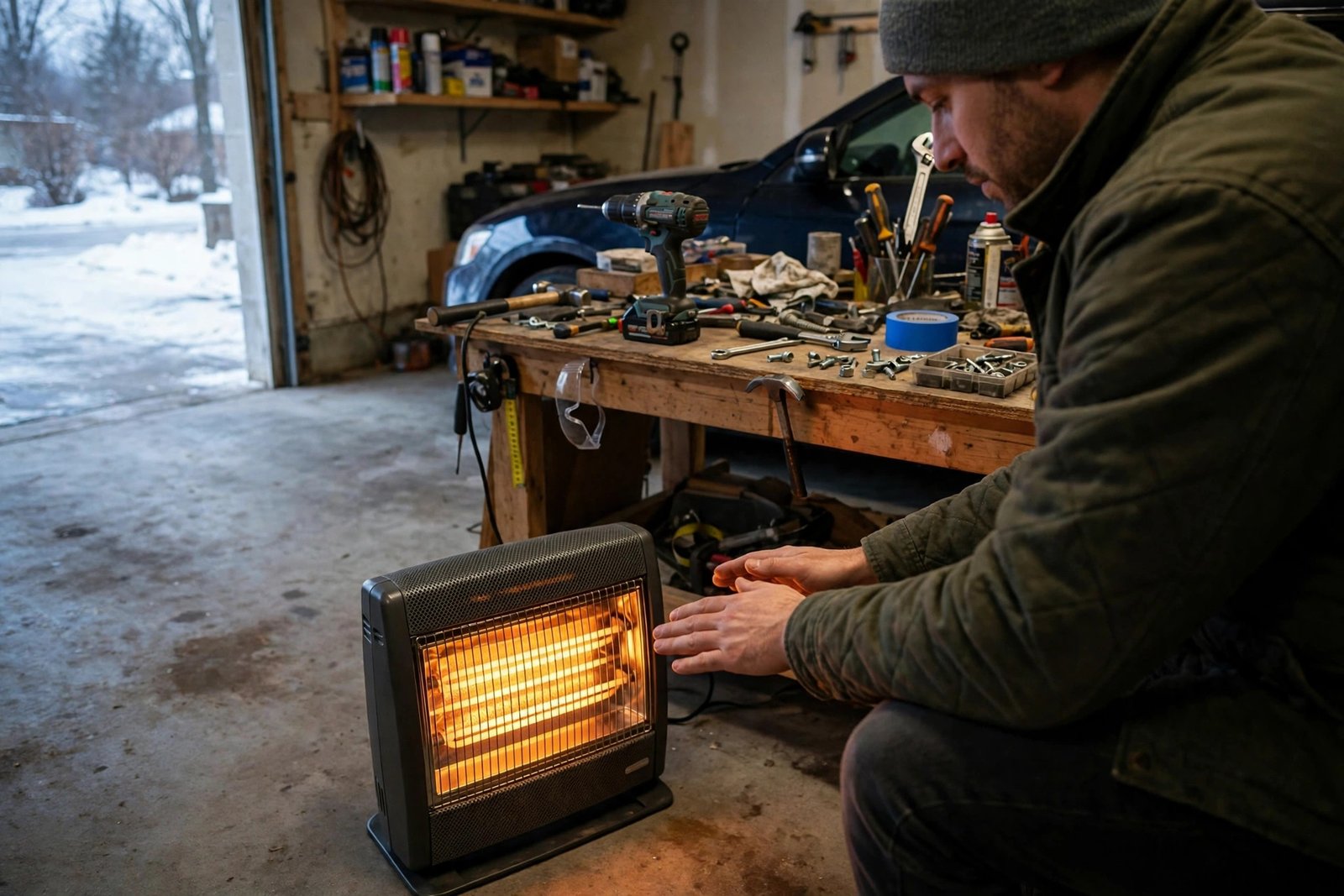
What Size Space Heater for a Garage? (Drafty, Uninsulated Rooms)

Grecian Finds is reader-supported. When you buy through links on our site, we may earn an affiliate commission — it never costs you extra.
A drafty, uninsulated garage needs about 15 watts per square foot — not the usual 10. That means a single-car garage of 240 square feet needs roughly 3,600 watts, and a two-car garage of 400 square feet needs about 6,000 watts. No single plug-in heater can deliver that: a standard US outlet tops out at 1,500 watts. So the honest answer is not a bigger plug-in heater. It is heat the corner you actually work in, run two heaters on separate circuits, or step up to a 240-volt heater on a dedicated circuit. Run your exact room through our space heater btu calculator with the drafty setting to get your number.
Why does the 10 watts per square foot rule fail in a garage?
The familiar rule — 10 watts per square foot — assumes a normal room: insulated walls, a sealed door, and an 8-foot ceiling. A garage breaks all three assumptions at once.
Most garages have uninsulated walls, a thin metal door with gaps around the edges, and concrete floors that suck heat away. Cold air pours in under the door and around windows every time the wind blows. In a room like that, heat escapes almost as fast as a heater can make it, so the standard rule under-sizes the heater by about half.
That is why the drafty-room figure is 15 watts per square foot. The maths is simple: a 150-square-foot drafty room needs 2,250 watts — already more than one 1,500-watt plug-in heater can give. A 240-square-foot one-car garage needs about 3,600 watts. And a 400-square-foot two-car garage needs about 6,000 watts. If you size a garage heater with the normal-room rule, you will end up cold and convinced the heater is broken, when the sizing was the problem.
For the general rule and how it works in normal rooms, see our guide on what size space heater do I need — this post covers only the garage and drafty-room case, where that rule stops working.
How many watts does a garage actually need?
Use 15 watts per square foot for a drafty or uninsulated garage, and 10 watts per square foot only if the garage is insulated and the door seals properly. Here is what that looks like in practice:
| Garage size | Insulated (10 W/sq ft) | Drafty / uninsulated (15 W/sq ft) | What it means |
|---|---|---|---|
| One-car, 240 sq ft (12 x 20 ft) | 2,400 W | 3,600 W | Two plug-in heaters, or one 240-volt heater |
| One-and-a-half-car, 300 sq ft | 3,000 W | 4,500 W | 240-volt heater territory |
| Two-car, 400 sq ft (20 x 20 ft) | 4,000 W | 6,000 W | A 240-volt heater, or heat one zone only |
| Two-car, 480 sq ft (20 x 24 ft) | 4,800 W | 7,200 W | 240-volt heater plus draft sealing |
| Workshop bay, 150 sq ft | 1,500 W | 2,250 W | One 1,500 W heater plus a small second heater |
Notice the pattern: almost every real garage needs more than 1,500 watts. That is the whole problem in one table. If you want the exact figure for your room, including the BTU conversion, use the what size space heater do i need calculator and pick the drafty-room setting — it does this maths for you.
Does ceiling height change the size of heater I need?
Yes — and garages are where it hurts most. The watts-per-square-foot rule is really about volume: it assumes an 8-foot ceiling. Many garages have 9- or 10-foot ceilings, and some workshops go higher still.
As a rough guide, add about 10 to 15 percent more watts for every foot of ceiling above 8 feet. A 240-square-foot garage with a 10-foot ceiling needs roughly 20 to 30 percent more heat than the same floor area with an 8-foot ceiling — so that 3,600-watt drafty figure becomes more like 4,300 to 4,700 watts.
High ceilings also trap warm air up high, away from where you are standing. A small fan on low, pointed up or across the ceiling, pushes that warm air back down and makes the heater you already have feel noticeably stronger. It costs almost nothing to run and it is the cheapest upgrade on this page.
Can one space heater heat a garage?
One 1,500-watt plug-in heater cannot heat a whole garage — not a one-car garage, and certainly not a two-car one. It puts out about 5,118 BTU per hour, which is enough for a 100-square-foot drafty room or a 150-square-foot insulated room. A garage is bigger and leakier than both.
What one heater can do is heat the zone you work in. Park a 1,500-watt heater near your workbench, point it at yourself, and you can be comfortable in a cold garage while the far corners stay cold. That is how most people actually use a garage heater: spot heat for the person, not whole-room heat for the building.
The Dr. Infrared DR-968 is a good fit for this job — a 1,500-watt cabinet heater with a thermostat and remote, around $104.99 on Amazon as checked 9 November 2026. It plugs into a normal outlet, needs no installation, and suits a workbench corner or one parking bay. Just do not expect it to warm the whole garage; that is not what any plug-in heater can do.
What are the honest options for heating a garage?
There are really three answers, and which one is right depends on your garage and your budget.
Option 1: Two plug-in heaters on separate circuits. Two 1,500-watt heaters give you 3,000 watts — enough for a one-car garage, or a work zone in a two-car garage. Each heater must be on its own circuit (more on that below). This is the cheapest route if your garage already has two separate circuits, and it needs no electrician.
Option 2: A 240-volt heater on a dedicated circuit. This is the proper answer for a whole two-car garage. A 240-volt heater like the Dr. Infrared DR-988 runs at 4,200 to 5,600 watts — about 14,300 to 19,100 BTU per hour — and is rated for up to 600 square feet. It costs around $104.19 on Amazon as checked 9 November 2026, but it needs a 240-volt, 30-amp circuit, which is a job for an electrician if you do not already have one. The heater itself is cheap; the circuit is the real cost. Get a quote before you buy.
Option 3: Propane for garages with no spare power. A portable propane heater such as the Mr. Heater Buddy (9,000 BTU, around $89.97 on Amazon as checked 9 November 2026) needs no outlet at all and works well for spot heat. But propane heaters burn fuel indoors, so only use one rated for indoor use, keep ventilation, keep it away from anything flammable, and never leave it running unattended or while you sleep. If your garage is your workshop and you are in and out, it is a practical option; it is not a set-and-forget heating system.
How do I run two space heaters safely in a garage?
Two heaters double the heat — and double the electrical load. A 1,500-watt heater draws 12.5 amps on its own. A standard 15-amp household circuit cannot carry two of them, and trying will trip the breaker at best.
- Separate circuits, always. Each heater goes on its own wall outlet on its own circuit. If both outlets are on the same circuit, the breaker will trip — check your breaker panel to find out which outlets share a circuit.
- Never use a power strip or extension cord. Plug each heater directly into the wall outlet. Power strips and light extension cords overheat under a 12.5-amp continuous load and are a genuine fire risk.
- Keep three feet of clear space. Keep every heater at least three feet from anything that can burn: cardboard boxes, rags, sawdust, paint cans, and fuel containers. Garages are full of flammable clutter — clear the zone first.
- Use heaters with tip-over and overheat shut-off. In a workshop, things get knocked over. A heater that switches itself off when tipped or overheated is not a luxury; it is the feature that matters most.
- Never leave a garage heater running unattended. Turn it off when you leave the garage, and never run a portable heater overnight in a garage.
Is sealing drafts better than buying more watts?
Usually, yes — and it is far cheaper. Every gap you seal is watts you do not have to buy, and unlike a heater, a draught seal keeps working without costing a cent to run.
Start with the garage door: a worn bottom seal and gaps around the sides can let in as much cold air as an open window. A replacement door seal costs a few dollars and takes minutes to fit. Next, weatherstrip the side door and any windows, and seal obvious gaps around pipes and vents with caulk or foam.
If you want a bigger step, insulating the garage door itself — with foil-backed foam panels or a door insulation kit — makes a real difference to how long heat stays in the room. None of this turns an uninsulated garage into a living room, but it can easily drop your heating need from 15 watts per square foot towards 12 or 13, which can be the difference between needing a 240-volt circuit and getting by with two plug-in heaters.
Seal first, then size the heater. Run the numbers again in the space heater btu calculator after sealing — you may find you need less heater than you thought.
What size space heater do I need for a drafty room that is not a garage?
The same 15 watts per square foot rule applies to any drafty, uninsulated room: a draughty basement, a sunroom, a converted porch, or an old room with single-pane windows. A 12 x 12 foot drafty room (144 square feet) needs about 2,160 watts — so one 1,500-watt heater plus a small 500- to 750-watt heater on a separate circuit, or accept that one heater will take the chill off rather than fully heat the room.
For rooms like these, the heater choice is the same as for a garage work zone: a 1,500-watt plug-in heater with a thermostat, aimed at where you sit, plus draft sealing. And if you are heating an outdoor space rather than a room, our guide to the best patio heater for a small balcony covers the outdoor side of the same problem.
Frequently asked questions
What size space heater do I need for a 2-car garage?
About 6,000 watts if the garage is drafty and uninsulated (400 square feet at 15 watts per square foot), or about 4,000 watts if it is insulated. No plug-in heater can do that alone — you need a 240-volt heater on a dedicated circuit, or two plug-in heaters on separate circuits heating the zone you work in.
Can a 1,500-watt heater heat a garage?
Not the whole garage. A 1,500-watt heater puts out about 5,118 BTU per hour, enough for roughly 100 square feet of drafty space. It can comfortably heat a workbench corner or one parking bay, but it will not warm a full one-car or two-car garage.
Can I run two space heaters in my garage?
Yes, but only on separate circuits. Each 1,500-watt heater draws 12.5 amps, and two on one 15-amp circuit will trip the breaker. Plug each heater directly into a wall outlet on its own circuit, never into a power strip or extension cord.
Is a 240-volt heater worth it for a garage?
If you use the garage all winter and want the whole room warm, yes. A 240-volt heater like the Dr. Infrared DR-988 delivers 4,200 to 5,600 watts and covers up to 600 square feet. The heater itself is around $100, but you will need an electrician to install the 240-volt, 30-amp circuit if you do not already have one — get a quote first, because the circuit is the real cost.
What size space heater do I need for a drafty room?
About 15 watts per square foot. A 150-square-foot drafty room needs about 2,250 watts, and a 12 x 12 foot drafty room needs about 2,160 watts. One 1,500-watt plug-in heater is not enough on its own — pair it with a smaller heater on a separate circuit, or seal the drafts first and re-check your number.
Do I need to insulate my garage before buying a heater?
You do not have to, but sealing the worst drafts first is the cheapest way to cut the size of heater you need. A new garage door seal and weatherstripping cost a few dollars and can drop your heating need noticeably. Insulate the door itself if you want a bigger improvement — then size the heater for the sealed garage, not the leaky one.
Bottom line: a garage is not a normal room, so do not size its heater like one. Use 15 watts per square foot, add 10 to 15 percent per foot of ceiling above 8 feet, seal the drafts, and then pick the honest fix — a heated work zone, two heaters on separate circuits, or a 240-volt heater. Run your garage through the what size space heater do i need calculator with the drafty setting before you buy, so the number you shop with is your room’s number, not a guess.